
Catch a trophy fish. Measure it correctly. Earn Tennessee TARP recognition.
The Tennessee Angler Recognition Program (TARP) rewards qualifying fish by length, not weight. Anglers of any age can apply for a Trophy Fish Certificate and work toward five Master Angler awards. You can document a fish, release it, and still apply.
Tennessee TARP: what actually qualifies?
Includes bass, trout, catfish, crappie, walleye, sunfish and more.
The completed Trophy Fish application must be mailed within 90 days of the catch.
Per Trophy Fish submission. Additional Master Angler awards have no separate award fee.
TWRA requires applicants age 13 and older to have a valid fishing license at the time of the catch.
TWRA established TARP in 2003. On April 22, 2026, the agency announced that the program had passed 10,000 entries. Its purpose includes celebrating anglers, encouraging trophy-fish release and documenting large fish caught across Tennessee.
The four conditions for a valid TARP catch
1. The fish reaches the species threshold
Measure the fish’s total length and compare it with the current TWRA TARP chart. A 22-inch largemouth bass qualifies; a 21.75-inch largemouth bass does not reach the listed 22-inch minimum.
2. It was caught legally in Tennessee
The catch must come from Tennessee waters and comply with sportfishing regulations, including the exact water’s access, season, methods, license and special rules.
3. The method is rod-and-reel or cane pole
TWRA specifies these sportfishing methods for TARP. A fish caught by a different legal harvest method does not automatically qualify for this recognition program.
4. The length is verified
Provide a qualifying measuring photograph or witness verification. TWRA may request a fish photograph even when another verification method was used.
Need to purchase or check your fishing privileges first? Use our Tennessee fishing license guide for the proper age, residency and official purchase route.
Does your fish meet the Tennessee TARP length?
Select the species and enter the fish’s actual measured length in inches. This tool compares your measurement with TWRA’s listed trophy threshold; it does not verify the catch or submit an application.
Use the current TWRA chart before mailing. Meeting the length alone does not establish legal catch, approved species identification, or acceptable documentation.
All 27 qualifying Tennessee TARP species and minimum lengths
There are 27 eligible species. Black and white crappie share a 14-inch threshold but count as different species for Master Angler diversity. Cherokee bass is the hybrid striped bass category.
| Fish species | Minimum trophy length | Measurement note |
|---|---|---|
| Largemouth Bass | 22 inches | Confirm species before submission. |
| Spotted Bass | 18 inches | Do not confuse with largemouth or smallmouth. |
| Smallmouth Bass | 20 inches | Check river or lake-specific bass regulations. |
| Striped Bass | 40 inches | Current TWRA threshold; older publications may differ. |
| Cherokee Bass (Hybrid Striped Bass) | 28 inches | Separate category from true striped bass. |
| White Bass | 18 inches | Do not substitute the hybrid-bass threshold. |
| Yellow Bass | 11 inches | Check identification carefully. |
| Black Crappie | 14 inches | Distinct from white crappie for Master Angler species totals. |
| White Crappie | 14 inches | Distinct from black crappie for Master Angler species totals. |
| Bluegill | 10 inches | Avoid confusion with redear sunfish. |
| Redear Sunfish | 11 inches | Often called shellcracker. |
| Rock Bass | 10 inches | Separate from black-bass species. |
| Sauger | 20 inches | Confirm it is sauger, not walleye or saugeye. |
| Walleye | 28 inches | Check water-specific harvest limits. |
| Yellow Perch | 11 inches | One of the smaller trophy-size thresholds. |
| Muskellunge | 40 inches | TARP length is separate from the legal harvest minimum. |
| Brook Trout | 10 inches | Requires correct trout fishing privileges where applicable. |
| Brown Trout | 26 inches | Tailwaters can have protected-length rules. |
| Rainbow Trout | 24 inches | Check special trout-water regulations. |
| Lake Trout | 28 inches | Confirm exact species and waterbody. |
| Channel Catfish | 28 inches | Distinct from blue and flathead catfish. |
| Blue Catfish | 36 inches | Check the rule for fish over 34 inches before retaining one. |
| Flathead Catfish | 36 inches | Check the rule for fish over 34 inches before retaining one. |
| Common Carp | 34 inches | Species identification still matters. |
| Freshwater Drum | 28 inches | Also called gaspergou. |
| Bowfin | 26 inches | Distinguish from invasive snakeheads. |
| Longnose Gar | 45 inches | Do not confuse with protected alligator gar. |
Five Master Angler levels—and how repeat species affect your progress
TARP has one basic Trophy Fish Certificate plus five Master Angler tiers. The important distinction is that Master Angler I counts qualifying trophy catches, while Master Angler II through V require qualifying catches from enough different species.
Master Angler I
Any combination of trophy-size catches. Certificate and patch.
Master Angler II
Species diversity becomes mandatory. Certificate and patch.
Master Angler III
Certificate, patch and a Bass Pro Shops gift-card award.
Master Angler IV
Certificate, patch and trophy.
Master Angler V
Certificate, patch and engraved plaque.
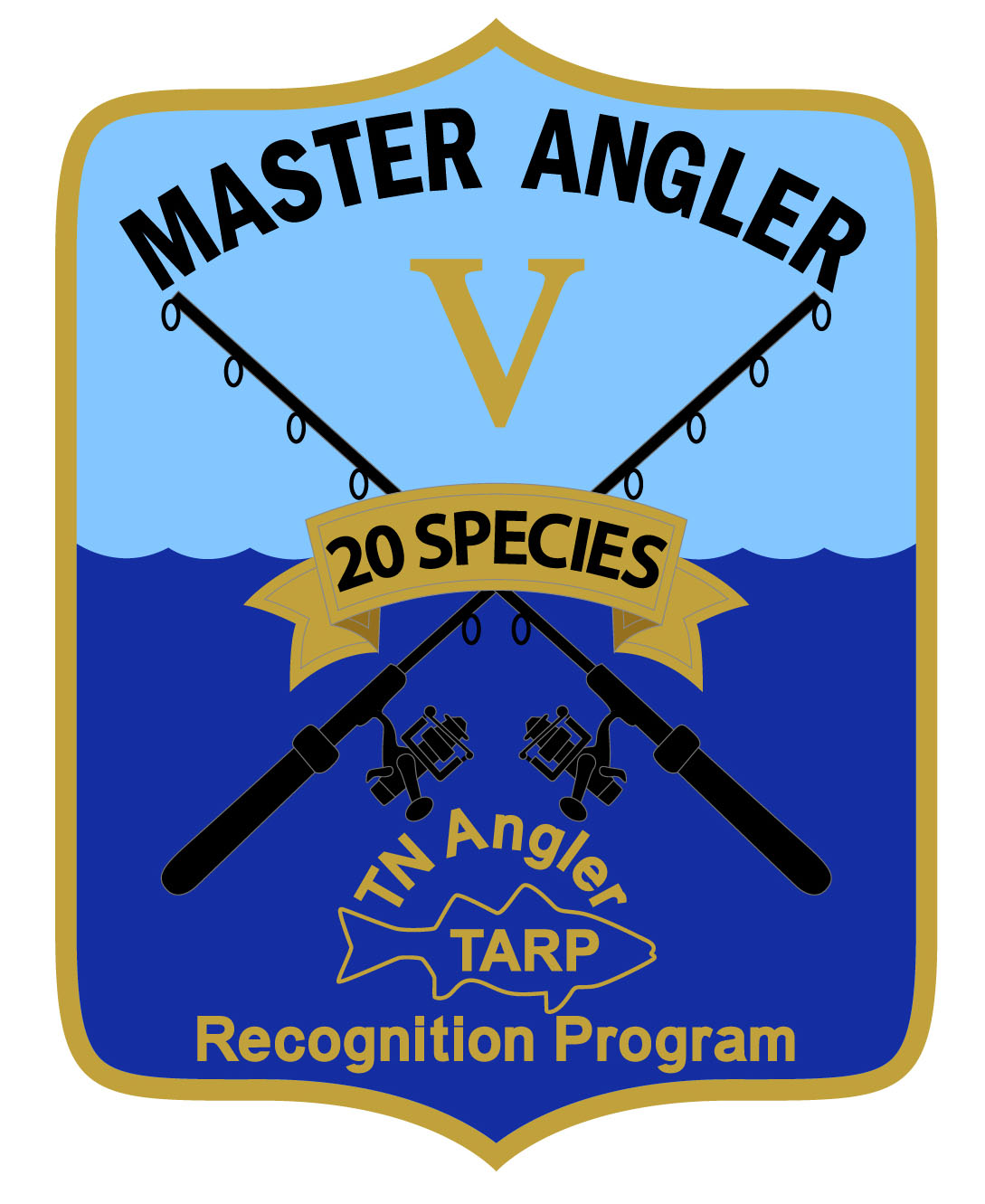
What does the top award look like?
TWRA’s Master Angler V recognition includes a patch and engraved plaque for anglers who reach 20 qualifying species. Image: official Tennessee Wildlife Resources Agency Master Angler V patch.
Awards are issued by TWRA after review, not generated by the progress tool below.
How close are you to your next Master Angler award?
Enter the number of qualifying TARP catches you have submitted and the number of different eligible species among those catches. Use accepted catches where possible; final award eligibility is determined by TWRA.
No account is created, and nothing entered in this tool is sent to TWRA. You must use the official application process for actual recognition.
How to photograph and measure a Tennessee trophy fish
TWRA allows fish length to be verified by a witness or a qualifying photograph. A fish-holding portrait is useful for memories, but a portrait alone may not prove the length.
Prepare it before the fish is landed so the measurement takes as little time as practical.
TWRA’s standard measuring method uses the mouth closed and the tail fin lobes squeezed together to establish total length. Do not manipulate the mouth to extend the measurement.
Show the nose, tail and readable measurement markings in the same image. Avoid camera angles, curled fish or obscured numbers that make the length difficult to verify.
The published Trophy Fish application requests length to the nearest quarter inch. Do not round a fish upward merely to meet a trophy threshold.
If using a witness, complete the witness section and contact information. TWRA may still request a photograph.
TARP encourages catch and release. Minimize air exposure, wet hands before handling and do not keep a fish merely for proof if a clear photograph can satisfy the application.
A waterproof measuring board, phone/camera, and a second person to assist with documentation can help prevent incomplete evidence. These are practical suggestions, not additional mandatory TWRA equipment requirements.
A trophy-sized fish may be legal to release but not legal to keep
40-inch muskie
A 40-inch muskellunge meets the TARP threshold. Whether it can be harvested still depends on the applicable fishing regulations, including any special-water restrictions.
36-inch blue catfish
A blue catfish reaches its TARP threshold at 36 inches. Tennessee’s statewide catfish rule generally allows only one catfish over 34 inches to be harvested per day, and special waters may have additional limits.
26-inch brown trout
A brown trout that reaches 26 inches may meet TARP length, but some Tennessee tailwaters have protected lengths, limited harvest or catch-and-release requirements.
45-inch longnose gar
Longnose gar is an eligible TARP species. Alligator gar is different and protected under Tennessee’s no-harvest rule. Verify identification rather than guessing.
For special waterbodies, trout privileges and supplemental access products, see the Tennessee fishing permit guide.
How to apply for a TARP Trophy Fish Certificate
The current TWRA process uses a downloadable Trophy Fish application, a witness or photographic length verification, a $5 processing fee per Trophy Fish submission, and mailing within 90 days of the catch.
Open TWRA’s Tennessee Angler Recognition Program page and confirm your species and minimum trophy length.
Open the “Qualify and Apply” section on TWRA’s page and download the form. If you cannot access it, call the TWRA Fisheries Management Division at 615-781-6575.
Record angler contact details, fishing-license/TWRA number when applicable, fish species, date caught, body of water, county, measured length and release information.
Complete the witness-verification section and/or attach the required qualifying photo. Ensure any photo is clearly identified with the applicant and species according to the form.
The form includes a declaration that the catch complied with fishing regulations and the submitted information is accurate.
TWRA directs applicants to include a check or money order payable to TWRA for each Trophy Fish application. The fee is not refunded when an application does not qualify.
Send the complete application, documentation and payment to the TARP mailing address printed on the current TWRA form. Multiple applications may be enclosed in one envelope.
Keep copies of the completed form, photo and mailing documentation. Contact TWRA Fisheries for questions about eligibility or processing rather than submitting a duplicate application immediately.
The official application may request sensitive personal information. Complete it only for TWRA’s intended submission method; do not upload identity details or payments to this independent guide.
Estimate the latest day to mail your TARP application
TWRA says applications must be mailed within 90 days from the catch date. Enter the date you landed your fish to calculate a planning deadline. Mail ahead of the final day to avoid postal delays and timing uncertainty.
This tool adds 90 calendar days. It does not establish a postmark exception, delivery guarantee or TWRA approval. Follow the agency’s actual deadline instructions.
Where qualifying trophy catches have been documented
TWRA’s public TARP photo gallery and submission summary document catches from major reservoirs, rivers, smaller lakes and ponds. These are recorded examples, not guarantees of future catches or specific fishing spots.
| Waterbody | Documented TARP catch | Why the example matters |
|---|---|---|
| Center Hill Reservoir | 21.75-inch smallmouth bass, May 2026 | Above the 20-inch smallmouth TARP threshold. |
| Dale Hollow Reservoir | 15.25-inch white crappie, April 2026 | Above the 14-inch white-crappie threshold. |
| Boone Lake | 41.5-inch striped bass, March 2026 | Above the current 40-inch striped-bass requirement. |
| Old Hickory Reservoir | 28-inch walleye, March 2026 | Exactly meets the 28-inch walleye threshold. |
| Chickamauga Reservoir | 31-inch freshwater drum, July 2026 | Exceeds the 28-inch freshwater-drum threshold. |
TARP vs. Tennessee State Record Fish: which application should you use?
Tennessee TARP Trophy Fish
- Based on: total fish length.
- Goal: meet the listed trophy-size threshold.
- Proof: witness or measuring photograph.
- Fee: $5 per Trophy Fish application.
- Deadline: mail within 90 days.
- Release: promoted and compatible with the program.
- Recognition: species certificate and progress toward Master Angler awards.
Tennessee State Record Fish
- Based on: certified weight.
- Goal: establish a new state weight record for the species.
- Proof: certified/legal-for-trade scale and required witnesses.
- Deadline: completed state-record application within 30 days.
- Species ID: TWRA fisheries biologist verification is required; a photograph alone is insufficient.
- Fish handling: formal examination can result in the fish’s death.
- Recognition: official state record.
Is TARP suitable for kids and first-time anglers?
Yes. TWRA allows anglers of any age to apply for TARP when the catch qualifies, but a 10-inch bluegill can be a major accomplishment without being a state record. Families should take a clear measuring photo, record the child’s actual catch details, and complete the official application together.
TARP Trophy Fish
For a qualifying fish that meets the species threshold. The ordinary application fee, documentation and deadline apply.
First Fish Certificate
TWRA also offers a separate free First Fish certificate. This celebrates a child’s first fish in Tennessee, regardless of fish size, and is not the TARP Trophy Fish award.
What should you budget before targeting your next TARP fish?
Fishing license
Most anglers age 13 or older need the appropriate Tennessee license at the time of the catch. The exact price depends on age, residency, duration and target species.
Trout or special permits
Trophy trout or special-area trips may require additional license privileges. A TARP award does not provide fishing access or a trout exemption.
TARP application
$5Processing fee per Trophy Fish application, payable to TWRA by the prescribed method. Postage and personal equipment are separate.
If you are specifically targeting rainbow, brown, brook or lake trout, compare the Tennessee all-species fishing license guide before heading to a stocked water or tailwater.
For resident, nonresident and short-term license price comparisons, see the Tennessee fishing license cost guide. Licensing and TARP processing are separate payments.
Common TARP application mistakes—and how to avoid them
- Using an older species chart. Check current lengths, especially striped bass.
- Using weight instead of length. TARP is length-based; state records use weight.
- Calling the wrong species. Spotted bass, largemouth, black/white crappie and true/hybrid striped bass need correct identification.
- Rounding a short fish up to qualify. Report the actual measured length.
- Taking only a trophy portrait. Use a readable measuring photograph or complete witness verification.
- Omitting license identification. TWRA requires the applicable fishing license number for applicants age 13 and older.
- Using a nonqualifying catch method. TWRA limits TARP submissions to legal rod-and-reel or cane-pole catches.
- Forgetting the fee. Include the required $5 per Trophy Fish application payable to TWRA.
- Sending the form late. Plan for the 90-day mailing requirement.
- Using an obsolete mailing address. Follow the current form or confirm with TWRA Fisheries.
- Assuming Master Angler I and II are the same. Five catches can qualify for Level I, while Level II needs five different species.
- Keeping a fish illegally. TARP eligibility does not override minimum lengths, protected slots or catch-and-release rules.
TWRA TARP contacts and forms
Tennessee TARP Fishing Program FAQs
What is the Tennessee TARP fishing program?
TARP stands for Tennessee Angler Recognition Program. It is run by the Tennessee Wildlife Resources Agency and recognizes legally caught trophy-size fish based on species-specific minimum lengths rather than state-record weights.
How many species qualify for Tennessee TARP?
The current TWRA program lists 27 qualifying species. These include separate black and white crappie categories, several bass and trout species, catfish, sunfish, walleye, sauger, muskellunge, carp, freshwater drum, bowfin and longnose gar.
How much does a TARP Trophy Fish Certificate cost?
TWRA requires a $5 processing fee for each Trophy Fish application. Make the check or money order payable to TWRA. Additional Master Angler awards do not have a separate award fee, although individual Trophy Fish submissions still have their normal processing costs.
How long do I have to submit a TARP application?
The completed TARP application must be mailed within 90 days from the date the fish was caught. The application, verification and applicable payment should be prepared and sent before that deadline.
Can I release a fish and still get a Tennessee TARP certificate?
Yes. TARP encourages catch and release. TWRA permits the length to be verified through a qualifying measuring photograph or witness verification, subject to the program’s documentation requirements.
What length largemouth bass qualifies for TARP?
A largemouth bass must measure at least 22 inches under the current TWRA TARP chart. For comparison, the smallmouth bass threshold is 20 inches and the spotted bass threshold is 18 inches.
What are Tennessee’s Master Angler I and II requirements?
Master Angler I requires five qualifying trophy-size fish in any combination. Master Angler II requires five different qualifying species. Each award includes a certificate and patch, subject to TWRA verification.
Do children need a fishing license to apply for TARP?
Anglers of any age can apply. TWRA requires applicants age 13 or older to have been properly licensed at the time of the catch and to provide their TWRA license identification number. Children under 13 are generally exempt from the ordinary fishing license requirement.
Is a TARP certificate the same as a Tennessee state fishing record?
No. TARP is a trophy-length recognition program. Tennessee state fish records are based on certified weight and require a separate process involving appropriate scales, witnesses and TWRA fisheries-biologist verification. The state-record application deadline is 30 days rather than TARP’s 90-day mailing requirement.
Where do I send my Tennessee TARP application?
Mail the completed application, length verification and required payment to the TARP address printed on the current TWRA Trophy Fish application form. Because historical form editions have listed different post-office box numbers, confirm the current address on TWRA’s program page or call the Fisheries Management Division at 615-781-6575.
Measured a qualifying fish? Complete the evidence while the details are fresh.
Confirm the current species threshold, record the waterbody, county and catch date, retain a readable measuring photograph or witness verification, and submit the completed TWRA form with the processing fee within 90 days.
This guide is independent of the Tennessee Wildlife Resources Agency. Final TARP qualification, recognition, award fulfillment and application requirements are determined by TWRA. Regulations and program requirements may change.
Visit official TWRA TARP program